
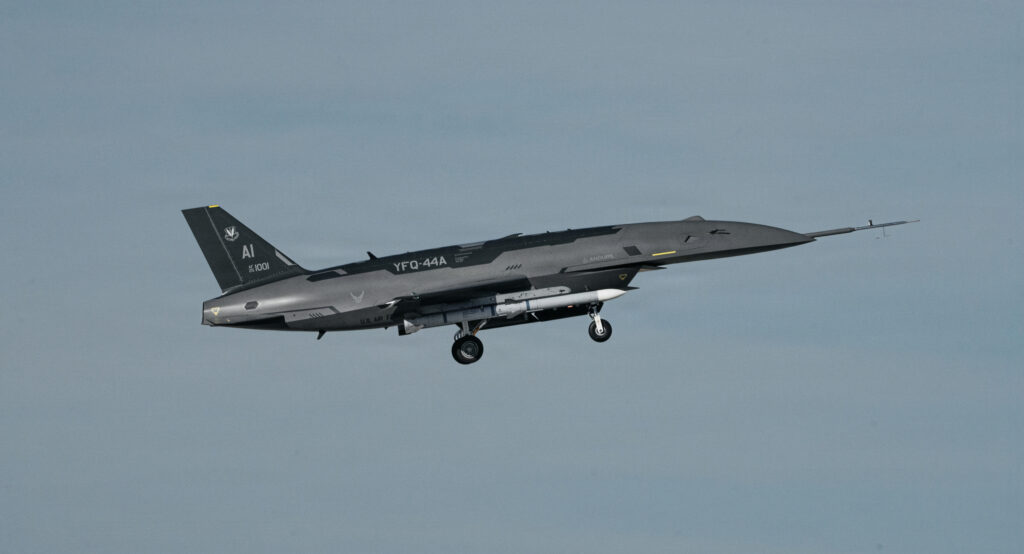
The autonomous Collaborative Combat Aircraft (CCA) of 2030 is expected to be far more versatile than the common perception of a jet-powered drone acting as a "missile truck." According to Honeywell Defense & Space President Matthew Milas, CCAs will likely conduct electronic warfare, relay targeting data, and loiter over contested territory, changing how missions are performed. The lineage of manned-unmanned teaming dates back to World War II, with the concept resurfacing after 9/11 when the Army formalized a doctrine pairing Apache helicopters with drones. The Air Force's CCA effort is the most advanced among US services. Increment 1 involves roughly 100 simple bomb-and-missile-carrying CCAs for experimentation, with initial contracts awarded to General Atomics and Anduril. Increment 2 has been redefined, and Increment 3 is envisioned as a higher-capability US-only version. The program is unusual for running three separate competitions for airframe, engine, and control software simultaneously. Other services are pursuing parallel paths: the Navy has issued contracts for a carrier-based drone wingman, the Marine Corps is pairing with Kratos' Valkyrie drone, and the Army has floated VTOL concepts, suggesting CCAs need not be jet-powered.
AI-Powered News Curation